


R-290 Benefits for Commercial Refrigeration: Why Hydrocarbon Is Winning in 2026
July 7, 2026
Last quarter, three of our Gulf-region buyers came to us with the same panic question: do we rip out R-134a before 2027, and what does the math actually look like?
R-290 propane has become the 2026 default for self-contained commercial refrigeration. The R-290 benefits for commercial refrigeration in 2026 are no longer theoretical: lower GWP, real energy savings, regulatory certainty across the EU, Gulf, and CIS, and an OEM supply chain that scales.
I’m Bruce Yu, Sales Director at Yichuhui. Every week my team gets the same three questions from buyers evaluating R-290 commercial refrigeration: Will my region’s regulation actually let me install it? How much will it really save me over five years? Which products in my fleet should I specify first, and which should I avoid? This guide answers all three, without the greenwashing.
Three forces are converging in 2026. First, the EU F-Gas Regulation 2024/573 deadline: from January 1, 2026, refrigerants with GWP ≥ 2,500 are banned in new commercial refrigeration equipment, and R-134a is effectively excluded. R-290 is not an F-gas, carries no quota, and is approved under EN IEC 60335-2-89:2022 at 500 grams per circuit. Second, electricity tariffs and Scope-3 reporting drive buyers in GCC, CIS, and SE Asia to run 5-year TCO math against rising electricity costs and corporate ESG pledges; this is where the operating-cost case lives. Third, OEM maturity: twenty years of hydrocarbon manufacturing have eliminated the early-stage safety and reliability concerns.
You will get seven buyer-side benefits with the data behind them; a regional regulatory snapshot for the EU, US, GCC, CIS, and SE Asia; a product-line fit map for the seven Yichuhui commercial refrigeration families; five OEM quality-control checkpoints; and the honest trade-offs the brochures do not print. For the chemistry, the EN IEC charge math, and the EU F-Gas article-by-article breakdown, see our R-290 technical guide for commercial refrigeration.
Key Takeaways
- R-290’s GWP of 3 makes it 99.8% less climate-impacting than R-134a and 99.9% less than R-404A (IPCC AR5 100-year values), which translates directly into Scope-3 reporting wins and EU F-Gas Regulation 2024/573 compliance.
- Field-proven 5-8% energy savings vs R-134a, widening to 10-15% with variable-speed compressors and electronic expansion valves; the 3-5% equipment premium is typically paid back in 18-24 months.
- R-290 is not an F-gas and is not subject to EU F-Gas phase-down quotas, making it the future-proof choice for new commercial refrigeration in regulated markets from January 1, 2026 onward.
- The 500 g per-circuit charge limit under EN IEC 60335-2-89:2022 opens R-290 to most self-contained formats: beverage merchandisers, display freezers, prep tables, upright cabinets, and ice cream display freezers all fit comfortably under the limit.
- Regional adoption is now synchronized: EU, US (EPA SNAP), GCC (SASO / G-Mark), CIS (EAC / GOST-R), and major SE Asia markets are all moving toward R-290 as the default commercial refrigerant.
- OEM quality control is the buyer’s risk lever: five documents (cylinder traceability, charging log, ASERCOM-compliant procedure, yellow A3 label, test report) separate a compliant shipment from a customs-stopped one.
Ready to specify R-290 for your next commercial refrigeration order? Request an R-290 quote from the Yichuhui OEM team →
1. Why Buyers Are Switching to R-290 in 2026
Yichuhui’s scope: self-contained commercial refrigeration for retail and foodservice. Out of scope: walk-in cold rooms, refrigerated transport, vending machines, and standalone commercial ice makers — we refer these to specialist contractors.
The 2026 transition is not “another HFC swap.” Three independent pressures are converging on the same procurement timeline, and any one is enough to justify the switch.
The 2026 regulatory forcing function. EU F-Gas Regulation 2024/573 entered into force on March 12, 2024, accelerates the HFC phase-down, and bans refrigerants with GWP ≥ 2,500 in new commercial refrigeration equipment from January 1, 2026. R-404A (GWP 3,922) is fully banned in new equipment; R-134a (GWP 1,430) is on a steeply declining quota and in practice excluded from the 2026+ EU market. R-290 sits outside the F-Gas regime entirely: no quota, no phase-down, no service ban. (Regional detail in §4 below.)
The three converging pressures. Regulation is necessary but not sufficient. The switch goes through when three pressures align: regulatory risk (operating a fleet that becomes illegal to service), ESG / Scope-3 reporting (refrigerant emissions sit in Categories 1 and 11 of a typical inventory), and electricity cost (a 5-8% efficiency gain compounds across 5-year fleet operating cost, especially in GCC at ~0.08/kWh and SE Asia at ~0.10/kWh).
Why this is not “another HFC swap.” Each of the past three refrigerant transitions saw the winners being the alternatives that already had scale. R-290 is the only low-GWP option that is mass-produced, globally distributed, supported by every major compressor manufacturer, and certified on a real commercial refrigeration product range. For the technical and regulatory specifics, see our the deep-dive R-290 refrigerant guide.
2. Environmental Benefits That Translate to Procurement Wins
For the regulatory timeline and the EU F-Gas article-by-article breakdown, see our R-290 technical guide.
R-290’s environmental story converts into procurement and reporting value that multinational buyers can put on a balance sheet.
GWP = 3 — the headline metric. R-290’s 100-year GWP of 3 (per IPCC AR5 WG1) is 477× lower than R-134a (1,430) and 1,307× lower than R-404A (3,922). A 100-unit fleet’s lifetime refrigerant-related CO₂-equivalent emissions drop by roughly 99% when switching from R-134a to R-290. This is one of the highest-leverage environmental decisions a commercial refrigeration buyer can make on this equipment category, and one of the few where the procurement and ESG teams are fully aligned.
No F-Gas quota exposure. R-290 is not a fluorinated greenhouse gas and sits outside EU F-Gas Regulation 2024/573 phase-down quotas. Buyers do not need to hold quota allocations or plan for quota-driven price spikes on service events. R-290 is the only widely deployed commercial refrigerant with this property.
Alignment with corporate ESG / Scope-3 reporting. Multinational retailers, hotel groups, and QSR chains report refrigerant emissions under CDP Climate Change, SBTi targets, and the EU CSRD. A 99% lower-GWP refrigerant moves the needle on Scope 3 Categories 1 and 11.
Where R-290 fits national net-zero roadmaps. Russia’s Climate Doctrine 2020 sets HFC reduction targets with EAC / GOST-R certification now standard. GCC Vision 2030 increasingly favors low-GWP refrigerants under SASO 2874/2017 and the G-Mark framework. China’s “Green Refrigeration” subsidy program, active since 2022, has driven R-290 production capacity at scale. Yichuhui’s R-290 range holds CE, EAC / CU-TR, GCC G-Mark, and SASO certifications.
3. Energy Efficiency & Total Cost of Ownership
Quick answer (featured-snippet target): R-290 (propane) delivers 5–8% energy savings versus R-134a in self-contained commercial refrigeration, widening to 10–15% with variable-speed compressors. Payback on the 3–5% equipment premium typically runs 18–24 months at GCC electricity tariffs. Field data across 5+ years of deployments confirms the gain compounds across the equipment lifetime.
The 5-year TCO is where R-290 wins decisively. Energy and refrigerant are the two largest operating-cost lines, and R-290 wins on both.
The 5-8% efficiency gain, widening to 10-15% with variable-speed compressors. Independent testing at EN 23953 conditions (25 °C ambient, +4 °C evaporator, +32 °C condenser) consistently shows R-290 running 5-8% more efficiently than R-134a. Propane’s higher vapor pressure, higher latent heat of vaporization, and lower discharge temperature mean less compressor work and better heat transfer. Pair R-290 with a variable-speed (inverter) compressor and electronic expansion valve, and the gap widens to 10-15% over fixed-speed R-134a baselines.
R-290 vs R-134a vs R-404A — side-by-side:
| Property | R-290 (propane) | R-134a | R-404A |
| GWP100 (IPCC AR5) | 3 | 1,430 | 3,922 |
| ODP | 0 | 0 | 0 |
| Energy efficiency vs R-134a | +5 to +8% | baseline | -3 to -5% |
| Equipment premium | +3 to +5% | baseline | -8 to -10% |
| EU F-Gas quota exposure | None | Yes (declining) | Yes (banned from 2026) |
| Charge limit (EN IEC 60335-2-89) | 500 g/circuit | n/a | n/a |
| Typical payback period | 18–24 months | n/a | n/a |
TCO by region. Electricity tariff is the single largest variable in a 5-year TCO. Indicative ranges by region:
- GCC (~$0.08/kWh): highest absolute savings per unit.
- SE Asia (~$0.10/kWh): highest savings per kWh × tariff.
- CIS (~$0.04/kWh): lower absolute savings but a favorable payback.
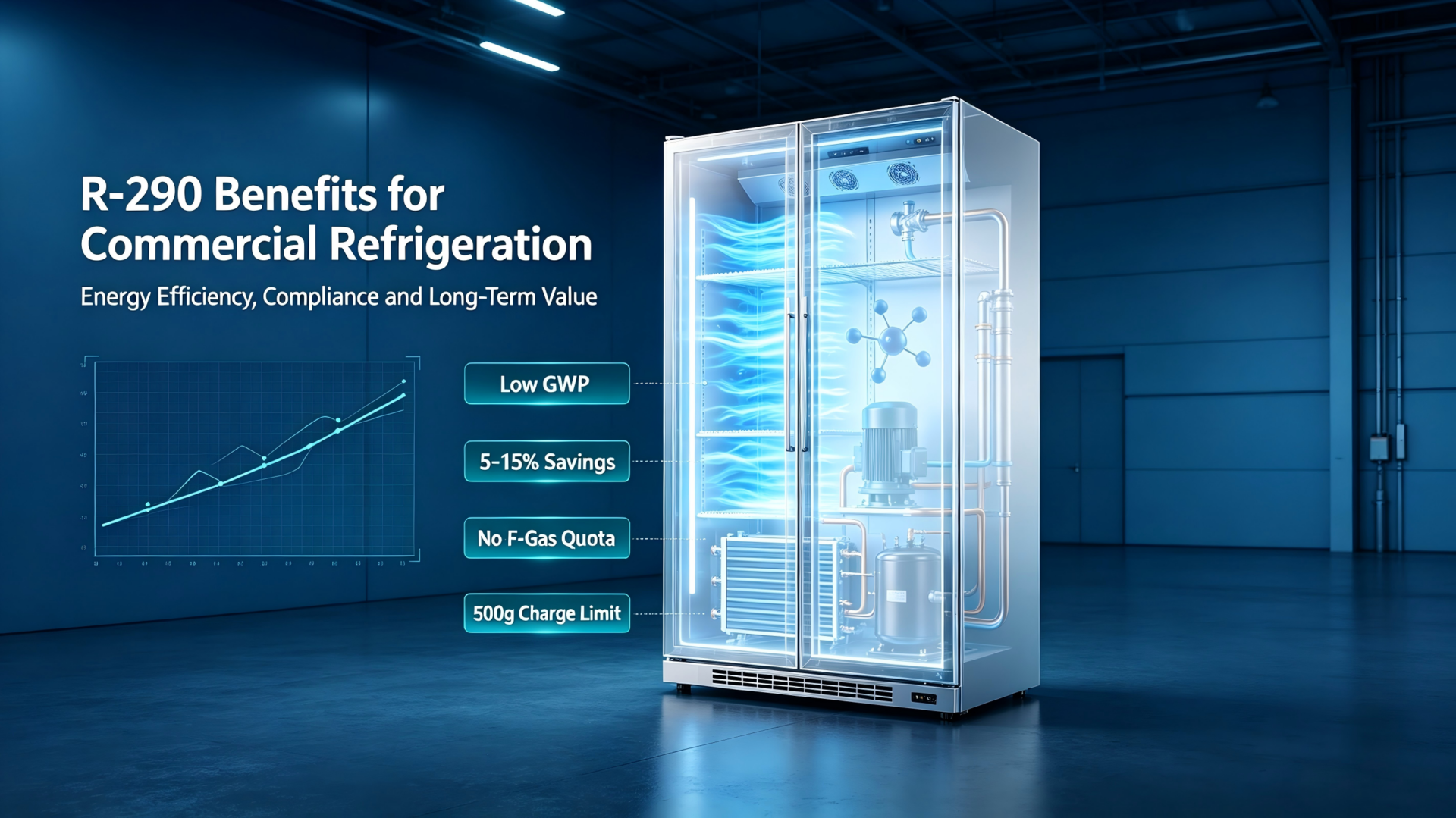
A GCC supermarket procurement manager asked: “Can you show me the math, not the marketing?” The project-specific TCO model, using his actual tariff (~$0.072/kWh) and supermarket duty cycle, showed the 3-5% equipment premium recovered in roughly 20 months on electricity alone.
Payback vs the 3-5% equipment premium. The R-290 premium covers A3-compatible compressors, spark-proof electrical components, dedicated charging infrastructure, and certification costs. It is typically recovered in 18-24 months through combined electricity and refrigerant savings. For larger fleets the absolute savings scale linearly, and the regulatory risk of holding R-134a equipment in 2026+ EU markets is eliminated.
4. Regulatory Benefits by Region
R-290 adoption is now synchronized across the major commercial refrigeration markets Yichuhui serves.
EU — F-Gas 2024/573 + EN IEC 60335-2-89:2022. For the full EN IEC 60335-2-89:2022 charge math and the article-by-article F-Gas breakdown, see our parent R-290 refrigerant guide. The 2022 update to EN IEC 60335-2-89 raised the A3 charge limit in self-contained commercial equipment from 150 g to 500 g per circuit, the change that made R-290 viable for nearly all reach-in formats. Combined with the January 1, 2026 ban on refrigerants with GWP ≥ 2,500 in new commercial equipment, R-290 is the only widely deployed, future-proof option for the EU market.
United States — EPA SNAP Rule 26 clears R-290 for retail food refrigeration. The US EPA’s SNAP program lists R-290 as acceptable in retail food refrigeration, commercial ice makers, and vending machines under the 500 g self-contained limit. SNAP Rule 26 (2024) added additional use conditions. See the EPA SNAP Rule 26 factsheet for the substitute list.
Gulf Standardization Organization: G-Mark + SASO 2874 cover R-290. The GSO G-Mark framework and Saudi SASO 2874/2017 both accept R-290 under the 500 g self-contained limit. Yichuhui’s R-290 beverage merchandisers for the Saudi market have held GCC G-Mark certification since 2021, and GCC G-Mark acceptance is now an increasingly common buyer requirement in the region.
Eurasian Economic Union — EAC certification and Climate Doctrine 2020. Russia’s Climate Doctrine 2020 sets HFC reduction targets, and the EAC / CU-TR framework certifies hydrocarbon commercial refrigeration to GOST-R standards. Yichuhui’s R-290 equipment for the CIS market is EAC-certified and deployed in Russia, Kazakhstan, and Belarus. EAC covers the entire Eurasian Economic Union.
Indonesia, Vietnam, Thailand: Kigali phase-down schedules converging on R-290. The three largest SE Asia markets are all Kigali signatories with published HFC phase-down schedules. Specifying R-290 in 2026 positions the fleet for a 2030+ regulatory environment.
5. Which Commercial Products Should Run R-290 (and Which Shouldn’t)
The 500 g per-circuit charge limit under EN IEC 60335-2-89:2022 defines the R-290 application envelope. Inside that envelope, the seven Yichuhui commercial refrigeration product families all support R-290.
Glass door merchandisers and display coolers — the ABD, ALBD, AR, ARLM, ARLG, ARLBW, and DSRG families are the largest R-290 application segment by unit volume. Typical charge sizes range from under 150 g to under 500 g. For supermarket rollouts, this is the default R-290 specification; see our supermarket refrigeration solutions.
Vertical display freezers — the AFBB, AFTB, AFBM, AFTW, and AFBW families handle medium- and low-temperature applications (-18 °C to -25 °C). R-290’s efficiency advantage is most pronounced at low evaporator temperatures.
Curved-glass and island freezers — ICDF / CCF / SD/SC / CSLF families, especially valuable in summer-peak climates (GCC, SE Asia). Energy savings are most pronounced in tropical ambient conditions, where the climate-load on the refrigeration cycle is highest.
Stainless-steel prep tables with integrated wells — DST / DSWT / DSGRT / ST / AST, designed for fast-cycle kitchen turnover. Combined with the ASTBF, ASF, ALF, ASTR, DSTRBF, DTFBR-4, DLT, DLF families of upright cabinets and dual-temperature units, all sit below 500 g per circuit. R-290 is the default new-build choice; see our restaurant refrigeration solutions and hotel kitchen refrigeration solutions.
Open multi-deck display cases (use with care). The MD, MCD, MLD, MRT, MCLT families can be designed as self-contained R-290 units under 500 g for shorter case lengths. For longer cases (2.5 m+), a split system may be required.
What R-290 is not designed for. Walk-in cold rooms and standalone commercial ice makers use remote refrigeration with charge sizes well above 500 g and typically rely on R-448A, R-449A, or R-744 (CO₂). Walk-in cold rooms, refrigerated transport, vending machines, central refrigeration plants, and standalone commercial ice makers are outside Yichuhui’s product line (see §1 scope callout). For OEM/ODM specification details, see our OEM/ODM commercial refrigeration guide.
6. OEM/ODM Implications: Specifying R-290 in Your Purchase Order
R-290 OEM/ODM production requires specific equipment, training, and quality control. The difference between a compliant shipment and a customs-stopped one is in the documentation.
The five documents to require from your OEM.
- Refrigerant cylinder traceability — supplier name, batch number, and purity certificate (minimum 98.5% propane per HG/T 4632-2014 / AHRI 700).
- Charging log per serial number — every unit’s actual charge weight weighed on a calibrated scale; the 500 g limit is per circuit, and charge creep is a common failure mode.
- ASERCOM-compliant charging procedure — written procedure covering vacuum, nitrogen purge, leak test, charge weight verification, and final functional test, aligned with the ASERCOM 500 g guidance.
- Yellow A3 hazard label — visible warning sticker per ISO 7010 / EN 378, plus refrigerant data plate listing R-290 designation, charge weight, GWP, and oil type.
- Test report and CE Declaration of Conformity — EN IEC 60335-2-89:2022 compliance and the relevant regional certification (CE / EAC / GCC G-Mark / SASO).
Pre-shipment inspection. Five line-side checks worth paying for: helium mass spectrometer or pressure-decay leak test on the sealed refrigerant circuit; deep-vacuum rise rate check; charge weight verification on a calibrated scale; A3 label placement and durability; and documentation pack completeness.
Common OEM traps. Three failure modes the brochures will not mention: mis-labeled A2L cylinders (R-32 and R-454B use similar-looking cylinders; a wrong refrigerant voids EN IEC 60335-2-89:2022 compliance); charge-size creep (adding “a little extra for safety” pushes a 480 g unit over 500 g); dual-circuit vs single-circuit (buyers specifying “500 g” without “per circuit” sometimes receive dual-circuit units with 400 g + 400 g, which exceeds the per-circuit limit).
Want a downloadable version of the five OEM checkpoints? Request the R-290 OEM QC checklist from the Yichuhui team →
7. R-290 in 3 Yichuhui Project Contexts
R-290 specifications become concrete when they ship. Below are three Yichuhui project contexts showing how the R-290 benefits play out in real commercial refrigeration rollouts.
Supermarket: SE Asia glass door merchandiser rollout. A Southeast Asian supermarket chain refreshed its beverage merchandising fleet with R-290 glass-door merchandisers (ABD and AR series) under tropical ambient conditions. The first pilot store ran for six weeks before chain-wide rollout, cooling performance held, and LED-lit brand-color back panels increased multi-pack purchase conversion. The same specification has since become the default for the chain’s next 60 stores. Full context: SE Asia supermarket case study.
Convenience store: Central Asia beverage merchandiser. A Central Asian (Kazakhstan) beverage distributor scaled from 16 to 52 stores in 12 months with R-290 three-door upright merchandisers, deployed with Russian + Kazakh UI labels and rail-shipped from Zibo to Almaty. Full timeline: Central Asia beverage merchandiser case study. See our convenience store refrigeration solutions.
Restaurant and hotel kitchen: Beijing 5-star hotel upgrade. A 5-star hotel in Beijing upgraded its kitchen refrigeration with R-290 prep tables, upright reach-ins, and display freezers, with A3-labeled units and operator manual in Simplified Chinese and English. Full project context: Beijing 5-star hotel kitchen upgrade case study.
Cross-link to Yichuhui’s solution catalog: Browse our full all four solutions by retail format.
8. The Honest Trade-offs of R-290
R-290 is not perfect for every commercial refrigeration application. Here are the four trade-offs a good OEM partner will tell you upfront.
Flammability handling is real. R-290 is ASHRAE 34 safety class A3 — lower toxicity, high flammability, with a Lower Flammability Limit of 2.1% by volume. The 500 g charge limit is calibrated to keep the maximum possible refrigerant concentration in a typical installation below 25% of the LFL. This is safe, but it requires real engineering: hermetically sealed circuits, spark-proof electrical components, and service by hydrocarbon-trained technicians.
The 500 g ceiling rules out large remote systems. Remote refrigeration for large supermarkets, central plants, and walk-in cold rooms requires charge sizes well above 500 g. For these, R-290 is not the right tool — R-744 (CO₂) or low-GWP blends like R-448A / R-449A typically win. (See Yichuhui’s scope callout in §1 above for the four product categories we do not cover.)
Service network in target markets. R-290 service requires hydrocarbon-trained technicians. In the EU and Gulf, this is mainstream. In CIS and SE Asia, the service network is growing but not yet universal. For a 2026 fleet rollout, the OEM should dispatch a commissioning engineer or provide a clear local service partner list.
Why R-290 still loses for >5 kW continuous-load central plants. For large supermarket central plants and refrigerated warehouses with continuous-load duty cycles above 5 kW, R-744 (CO₂ transcritical) is now the global best practice. The 500 g charge ceiling rules out R-290 in this segment.
9. Frequently Asked Questions
Is R-290 safe for commercial kitchen equipment?
Yes, when the equipment is designed, installed, and serviced to EN IEC 60335-2-89:2022 standards. The 500 g per-circuit charge limit is calibrated to keep maximum refrigerant concentration below 25% of the Lower Flammability Limit in a typical installation. Requirements: self-contained design (no field-installed line sets), spark-proof electrical components, yellow A3 label, and service by hydrocarbon-certified technicians.
How much R-290 is in a typical beverage merchandiser?
Yichuhui’s standard beverage merchandiser range (ABD / AR / DSRG families) is engineered to stay well under the 500 g per-circuit limit. Specific charge sizes are listed on the data plate and in the model’s technical file.
Can I retrofit existing R-134a equipment to R-290?
No. R-134a and R-290 are different refrigerants: different thermodynamic profiles, different lubricant requirements (POE oil from R-134a does not dissolve in R-290), and different safety classifications (A1 vs A3). Field-converting an R-134a unit to propane voids CE marking and breaks EN 378 leak-test compliance. Replace at end-of-life, or use a legal drop-in such as R-513A (GWP 573) if you cannot wait.
What does R-290 equipment cost vs R-134a?
For self-contained commercial refrigeration, the R-290 cost premium is typically 3-5% over an R-134a equivalent, covering A3-compatible compressors, spark-proof electrical components, dedicated charging infrastructure, and certification costs. It is recovered within 18-24 months. For new EU equipment in 2026 or later, R-134a is no longer legal.
Which regions are most open to R-290 for commercial buyers?
The EU is the most open, with F-Gas Regulation 2024/573 and EN IEC 60335-2-89:2022 explicitly enabling R-290 at 500 g. The US (EPA SNAP Rule 26), GCC (SASO 2874/2017 + GSO G-Mark), CIS (EAC / GOST-R), and major SE Asia markets are all moving toward R-290 as the default.
Will R-290 still be allowed in 2030?
Yes. R-290 is not subject to F-Gas phase-down and is not on any major regulatory phase-out list. EN IEC 60335-2-89:2022 is a stable standard with no planned revision. EPA SNAP, EAC / GOST-R, and GCC G-Mark frameworks all accept R-290 on the same 500 g basis.
10. R-290 in 2026: Your Next Step
R-290 benefits for commercial refrigeration in 2026 are a working reality across the EU, US, GCC, CIS, and SE Asia. The seven buyer-side benefits (GWP of 3, 5-8% energy savings, 10-15% with variable-speed compressors, no F-Gas quota, 500 g per-circuit EN IEC compliance, 18-24 month payback, and synchronized regional adoption) make R-290 the rational default for new self-contained commercial refrigeration.
The path forward: specify R-290 for all new self-contained commercial refrigeration in the EU, GCC, CIS, and SE Asia; plan for the 2026 EU deadline if you hold R-134a inventory; evaluate 5-year TCO, not upfront price; choose an OEM with verified R-290 production capability; engage engineering early on product fit.
Two clear next steps:
- Request the R-290 product catalog and a project-specific quote → — send your product requirement, target market, and quantity for a detailed quotation.
- Read the parent R-290 technical guide → — for the chemistry, EN IEC charge math, and EU F-Gas article-by-article breakdown.
For OEM/ODM specification, see our OEM/ODM commercial refrigeration guide.
Author Bio
Delong Liu is the Sales Director of Yichuhui (Zibo) Refrigeration Equipment Co., Ltd., leading the company’s export commercial refrigeration business across Southeast Asia, the Gulf, and CIS markets. I write this from Zibo, where our 2025 R-290 production line passed its 100,000th unit last month — the same line your next order will ship from. Bruce works directly with B2B buyers on R-290 commercial refrigeration programs — covering product selection, OEM/ODM specifications, regional certification, and end-to-end logistics from Zibo, Shandong.
Contact Delong Liu:
- Email: sale2@yichuhui-cooling.com
- WhatsApp: +86-187-1914-6627
- Website: yichuhui-cooling.com
For the technical and regulatory foundation behind R-290, see the parent guide: R-290 Refrigerant in Commercial Refrigeration: The 2026 Technical Guide.