Southeast Asia Supermarket Chain Case Study: From Japanese Equipment to Chinese OEM Partnership
June 30, 2026
Project Background
In early 2023, the procurement director of a rapidly growing supermarket chain in southern Vietnam faced a familiar dilemma. His company was expanding from 12 to 32 stores across Ho Chi Minh City and surrounding provinces, and the refrigeration equipment bill was becoming unbearable.
“We were quoted $3,200 per unit by a Japanese brand for their standard glass door merchandisers,” he told us during our first call. “For 120 units across our new stores, that was nearly $385,000 — before shipping, installation, or duties. And the lead time was 7 months.”
The company had built its reputation on offering premium produce and fresh prepared foods at competitive prices. Cutting corners on refrigeration was not an option — equipment failures meant food waste, regulatory risk, and damaged customer trust. But the math simply did not work at Japanese pricing.
After 6 weeks of searching for alternatives, his team found Yichuhui through an industry referral. Three months later, the first 40 units were installed and operating in the chain’s flagship Ho Chi Minh City stores.
Customer Requirements
The Vietnamese supermarket chain had three non-negotiable requirements:
1. Temperature reliability in tropical climate
Southern Vietnam operates at 30–36°C ambient temperatures year-round, with humidity often exceeding 80%. The refrigeration system needed to maintain consistent 2–8°C for fresh produce and beverages without compressor strain or temperature fluctuation. Their previous equipment — a mix of Japanese and Korean brands — had a documented 23% higher failure rate in the hot season compared to temperate climate specifications.
2. Energy efficiency for 18-hour daily operation
Each store runs from 7 AM to midnight, 363 days a year. Energy costs represent the second-largest operational expense after rent. The client required equipment with genuine energy savings, not just a rating on paper.
3. Custom sizing for Vietnamese retail layouts
Standard international refrigerator dimensions often create wasted aisle space in Vietnamese supermarkets, where floor plans tend toward narrower lanes and higher shelf density. The chain needed a custom depth and width configuration that maximized product display within their existing store footprint.
Custom Commercial Refrigeration Solution
Yichuhui’s engineering team spent two weeks reviewing the supermarket chain’s floor plans, product mix, and expansion roadmap before presenting a solution.
Custom Glass Door Merchandiser — SE Asia Tropical Model
Based on the client’s requirements, Yichuhui developed a tropical-grade glass door merchandiser with the following custom specifications:
Specification
Standard Model
Yichuhui Custom SE Asia Model
Climate Class
Class 3 (up to 25°C)
Class 5 (up to 40°C) — tropical rated
Compressor
Standard efficiency
High-efficiency Mitsubishi/Embraco scroll
Refrigerant
R-290
R-290 (lower GWP, better efficiency in heat)
Door Closing
Standard hinge
Soft-close auto mechanism
Interior Lighting
LED strip
Triple-zone LED with product-facing spotlight
Shelf Capacity
80 kg/shelf
100 kg/shelf reinforced
Defrost System
Manual
Automatic hot gas defrost
Custom Dimensions
Dimension
Client Request
Yichuhui Solution
Width
Maximize product facings in narrow lanes
1000mm (custom, standard is 1200mm)
Depth
Fit existing gondola layouts
750mm (custom, standard is 850mm)
Height
Full product visibility at eye level
2100mm with adjustable shelf heights
Quantity and Configuration
Product Model
Quantity
Temperature Zone
Single-door glass door merchandiser
60 units
2–8°C (beverages, dairy, condiments)
Double-door glass door merchandiser
30 units
0–5°C (fresh meat, seafood, prepared foods)
Triple-door glass door merchandiser
10 units
0°C~-18°C (frozen foods, ice cream)
Stainless steel prep counter (custom)
20 units
Built-in 2–8°C storage for in-store food prep
Total: 120 units across 32 stores over a 9-month rollout.
Production and Quality Control Process
Manufacturing Timeline
Phase
Duration
Details
Engineering review & drawing approval
2 weeks
Client approved custom dimension drawings
First article sample production
3 weeks
One unit per configuration for client inspection
Sample shipping to Vietnam
3 weeks
Sea freight, Ho Chi Minh City port
Client approval and feedback
1 week
Minor adjustments to shelf bracket design
Mass production (all 120 units)
5 weeks
Two production lines dedicated to this order
Quality inspection & testing
1 week
100% run-in test at Yichuhui facility
Crating and documentation
3 days
Export crating, COO, BL, commercial invoice
Shipping (3 shipments)
4–6 weeks
Sea freight to Ho Chi Minh City
Installation support (remote)
Ongoing
Video calls, installation manuals in Vietnamese
Quality Control Protocol
Every unit underwent a 48-hour continuous run test before leaving the factory, including:
Temperature stabilization verification at ambient temperatures of 25°C and 38°C
Door seal integrity test
Compressor cycling analysis
Energy consumption measurement
Noise level verification (target: < 45 dB)
The client also commissioned a third-party inspection (SGS or Bureau Veritas) for the first container shipment, at their own cost, as an additional quality verification step.
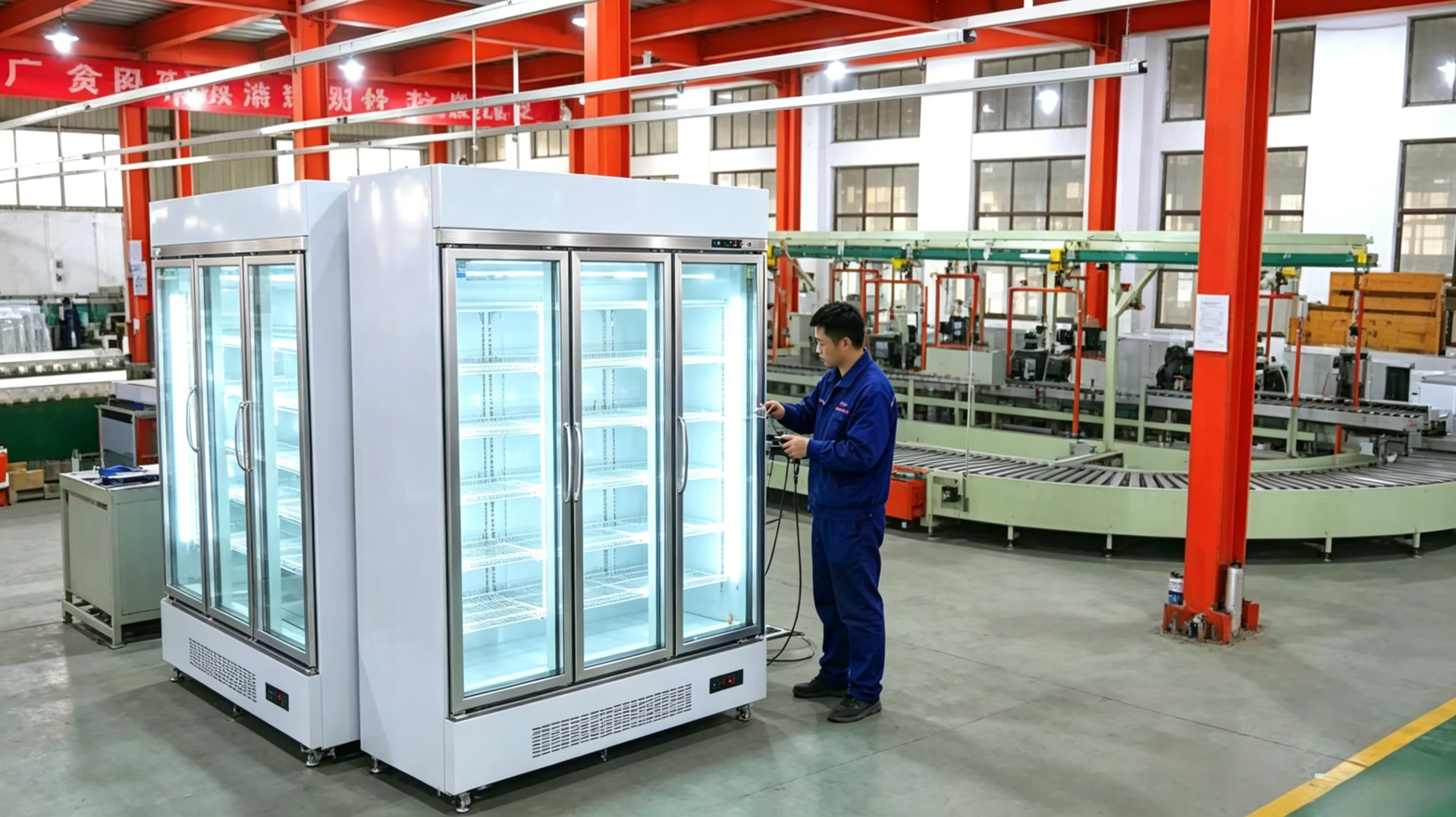
Factory quality test for tropical grade commercial glass door chiller, 48 hours continuous temperature stability test
Results and Outcomes
Eight months after the initial inquiry, all 120 units were installed across 32 stores. The procurement director shared the following results during a 6-month follow-up call:
Cost savings
“We paid $1,750 per unit on average, including sea freight and duties. Against the Japanese quote of $3,200, we saved roughly $174,000 on equipment alone. That’s before counting the energy savings.”
Energy performance
“Our energy bill per store dropped about 18% compared to the old Korean equipment we were running. The R-290 units in the tropical climate spec really do perform differently — the compressor isn’t struggling like the old units did.”
Operational improvements
“We’ve had zero compressor failures in 6 months. The old equipment was giving us 3–4 service calls per store per year. At our service rates in Vietnam, that’s real money.”
Food waste reduction
“Temperature consistency is noticeably better. Our produce spoilage rate dropped from about 8% to under 4% in the first quarter. That’s significant when you’re handling that volume.”
The tropical climate class specification was the single most important custom decision in this project. Standard Class 3 equipment (rated for up to 25°C) is designed for European and North American supermarket environments — not Southeast Asian heat and humidity. Paying the small premium for Class 5 tropical-rated components (about 8% higher unit cost) delivered disproportionate reliability gains in this operating environment.
What the client wished they had known earlier
The procurement director mentioned that they underestimated the complexity of coordinating a multi-store rollout:
“The equipment was the easy part, honestly. Managing the installation across 32 stores in 3 cities — coordinating with local electricians, getting the right floor configurations in place — that was the hard part. If we did it again, we’d start the installation planning 3 months before the first container arrived.”
This is a common pattern with large OEM projects: the manufacturing timeline is predictable, but the local installation coordination often creates the real bottlenecks.
Why custom dimensions mattered
Standard 1200mm-wide merchandisers would have created 200mm of dead aisle space per unit on each side in the client’s store layout. Across 90 standard-width units, that represented nearly 40 square meters of wasted floor space — space that, at Vietnamese retail rents, costs approximately $12,000 per year. The custom 1000mm width was a no-brainer financially.
Conclusion
This case study illustrates a pattern we see repeatedly with Southeast Asian retail chains: the assumption that Japanese or Korean brands are the only viable option for reliable commercial refrigeration is increasingly outdated.
Chinese OEM manufacturing has closed the quality gap significantly over the past decade, particularly in tropical-grade climate specifications. The key is working with a manufacturer that has documented experience in your target climate zone and is willing to customize — not just sell from a standard catalog.
For supermarket chains and food retail operators in Vietnam, Thailand, Indonesia, the Philippines, and Malaysia, the economics of Chinese OEM now make strong commercial sense at almost any scale, provided you:
Specify tropical climate class (Class 5) equipment
Invest in a sample unit before committing to full volume
Budget for third-party inspection on the first shipment
Start installation planning early in the production cycle
Yichuhui currently serves supermarket and food retail clients across 14 countries in Southeast Asia, Central Asia, and the Middle East. Custom specifications, tropical-grade engineering, and 20+ years of OEM experience are available for new partnerships.
Get Started
Ready to explore OEM commercial refrigeration for your supermarket or retail chain?