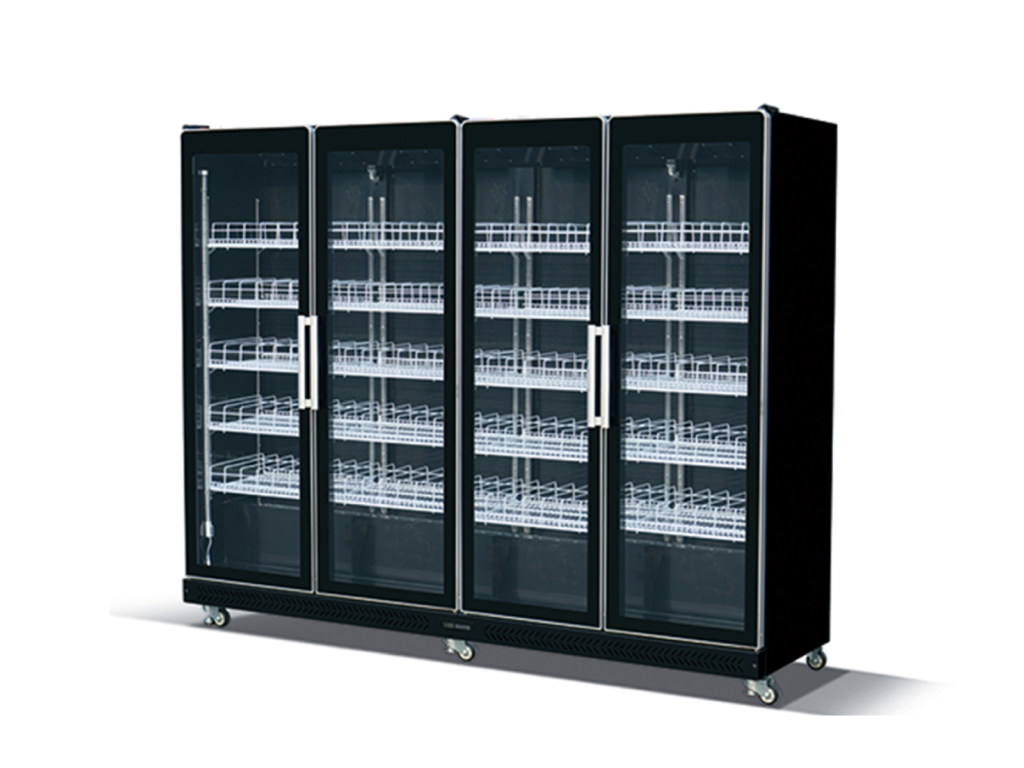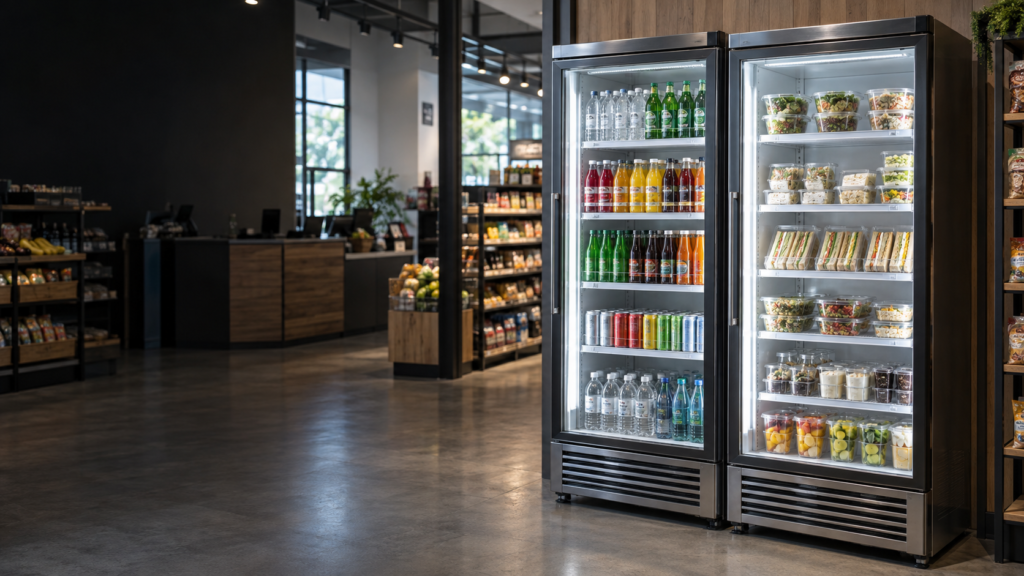
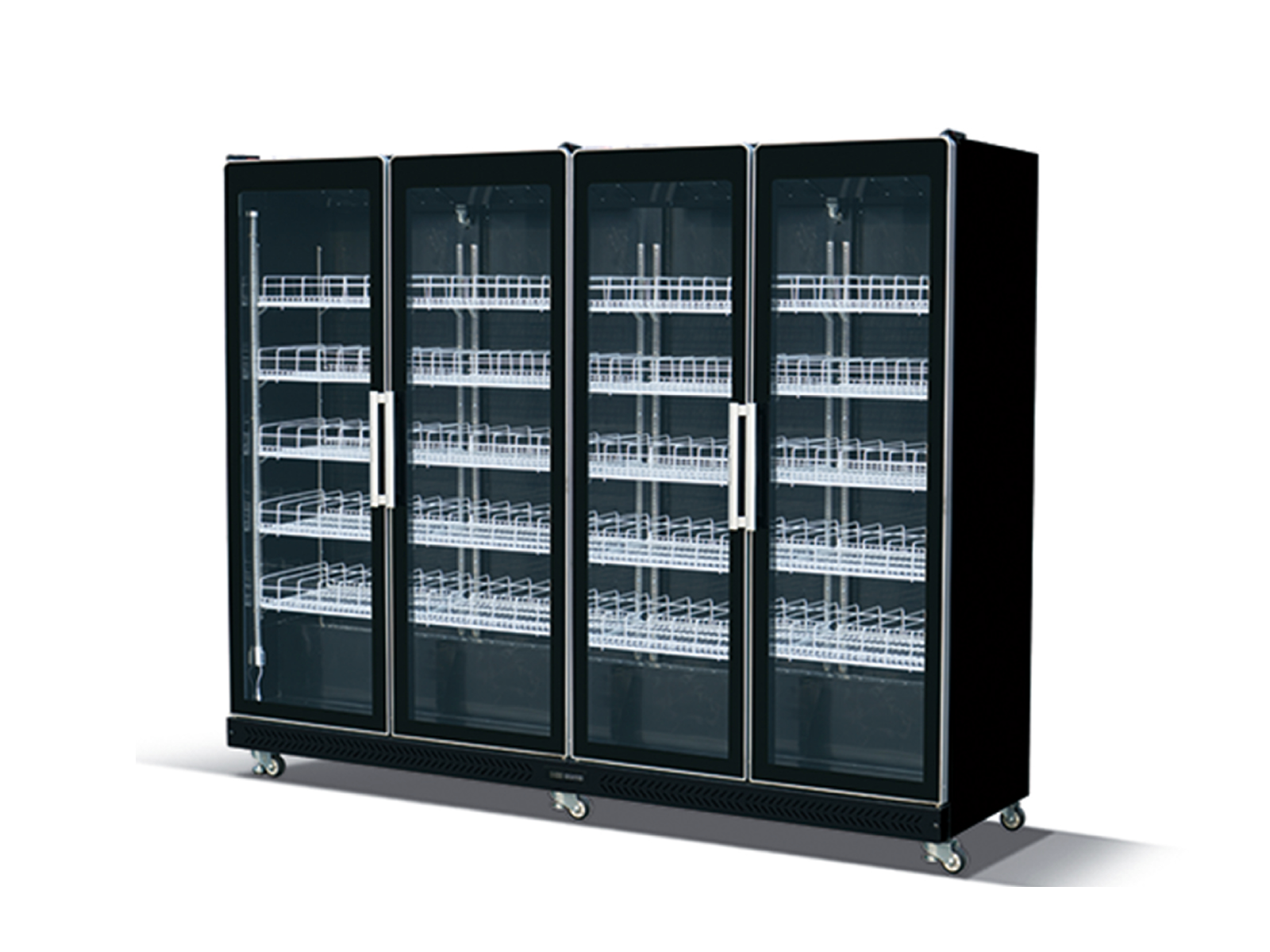
A commercial beverage cooler helps businesses keep drinks chilled, organized, and visible to customers. However, choosing the right unit involves more than selecting a glass-door refrigerator with sufficient storage space.
Retailers, restaurant operators, hotel buyers, and equipment distributors need to consider product capacity, temperature range, installation conditions, electricity supply, and daily operating requirements.
This guide explains where commercial beverage coolers are used, how to select the right size, and how to determine whether a particular model is suitable for your business.
Where Are Commercial Beverage Coolers Used?
Convenience Stores and Mini Markets
Convenience stores use beverage coolers to display bottled water, soft drinks, juice, and energy drinks.
For these businesses, visibility, customer access, and regular restocking are important. A glass-door cabinet allows shoppers to identify drinks without opening every door.
Smaller stores may prefer a single-door cabinet, while higher-volume locations may require two or three doors.
Supermarkets and Grocery Stores
Supermarkets often require larger beverage displays to accommodate multiple brands, bottle sizes, and product categories.
Two-, three-, and four-door beverage coolers can provide more organized display space.
Buyers should evaluate the available floor area, expected sales volume, shelf arrangement, and operating costs before choosing a larger cabinet.
Hotels, Bars, and Restaurants
Hospitality businesses use beverage refrigerators to store and present chilled drinks in guest areas, lounges, and service stations.
Cabinet appearance may be particularly important. Black, white, gray, and mirrored finishes can complement different interior designs.
However, installation dimensions must be checked carefully. A full-height upright beverage cooler is not interchangeable with an undercounter bar refrigerator.
Offices and Commercial Lounges
Office break rooms, reception areas, and business lounges may need a beverage refrigerator for bottled water and other refreshments.
In these applications, storage demand may be lower than in a busy retail environment. A smaller unit may provide sufficient capacity while using less floor space.
Fitness Centers and Sports Facilities
Gyms and sports venues frequently offer bottled water, sports drinks, and energy beverages.
A suitable beverage cooler should provide convenient access, adequate space for different packaging formats, and sufficient capacity for peak visitor periods.
How to Choose the Right Beverage Cooler Size
The first step is to determine how many beverages need to be displayed and how frequently the cooler can be restocked.
Yichuhui offers selected upright air-cooled beverage cooler models in four configurations:
| Configuration | External Dimensions (W × D × H) | Effective Volume |
|---|---|---|
| Single Door | 600 × 650 × 2020 mm | 385 L |
| Two Door | 1200 × 650 × 2020 mm | 832 L |
| Three Door | 1800 × 650 × 2020 mm | 1,277 L |
| Four Door | 2400 × 650 × 2020 mm | 1,723 L |
These specifications refer to a selected standard product series. Other configurations may differ.
Effective volume is not the same as the number of bottles or cans that will fit inside. Shelf arrangements, beverage dimensions, and airflow clearance all affect actual storage capacity.
Before purchasing, estimate:
- Expected beverage sales or consumption during peak periods
- Number of different beverage products (SKUs)
- Bottle and can dimensions
- Restocking frequency
- Available installation space
These details provide a more reliable basis for choosing cabinet size than nominal volume alone.
What Temperature Range Should You Choose?
Temperature compatibility is one of the most important selection criteria.
Selected Yichuhui air-cooled beverage coolers have a specified operating temperature range of 2–8°C.
This range is suitable for many common chilled beverage applications, provided that the selected temperature also meets the product manufacturer’s storage requirements.
However, different beverages may have different preferred serving or storage conditions.
Buyers should verify whether the intended products require:
- General refrigerated display
- A specific chilled serving temperature
- More precise temperature control
- Frozen storage
- Separate temperature zones
A standard beverage cooler should not be selected for frozen products or goods requiring temperatures outside its rated range.
Why Does Air-Cooled Refrigeration Matter?
Air-cooled beverage coolers use forced-air circulation to distribute chilled air inside the cabinet.
This design supports temperature distribution across the display area, which is useful when different shelves contain bottled and canned beverages.
Nevertheless, performance depends on more than the refrigeration method. Buyers should also evaluate:
- Compressor and refrigeration system specifications
- Door sealing performance
- Cabinet insulation
- Temperature controller
- Shelf arrangement
- Ambient operating conditions
Excessive loading can obstruct airflow and reduce cooling performance.
How to Determine Whether a Beverage Cooler Is Suitable
Before placing an order, evaluate the actual installation and operating environment.
1. Check the Installation Dimensions
Measure the available floor space, ceiling clearance, door-opening area, and delivery access.
A cooler must fit not only in its final position but also through the building entrance and installation route.
2. Verify the Ambient Temperature Rating
A refrigerator’s operating performance depends partly on the surrounding temperature.
For hot climates, outdoor venues, or spaces without air conditioning, ask the manufacturer to confirm the cabinet’s climate-class rating and maximum recommended ambient temperature.
Do not assume that a standard indoor beverage cooler is suitable for outdoor installation.
3. Confirm the Electrical Requirements
Some Yichuhui standard beverage cooler models specify 220V/50Hz.
International buyers should confirm compatibility with the electrical supply in their destination country before ordering.
Any alternative voltage or frequency requirement should be discussed with the manufacturer in advance.
4. Compare Energy Consumption
Purchase price is only one part of total ownership cost.
Buyers should also compare rated power, declared daily electricity consumption, expected operating hours, and maintenance requirements.
Energy-consumption data should be interpreted alongside the manufacturer’s stated testing conditions.
5. Review Beverage Display Requirements
For customer-facing installations, glass-door visibility and shelf layout are important.
Consider whether the cabinet can accommodate the intended bottle heights, can sizes, product labels, and desired display quantities.
6. Confirm After-Sales and Procurement Details
For wholesale or international orders, ask for model-specific specifications, packaging dimensions, warranty terms, spare-parts arrangements, and applicable compliance documents.
Distributors should also confirm available OEM options, branding requirements, minimum order quantities, and production lead times.
When Is a Commercial Beverage Cooler Not the Right Choice?
A beverage cooler may not be suitable when:
- Products require frozen storage.
- The required temperature falls outside the model’s rated range.
- The installation area has insufficient ventilation.
- The available space only allows undercounter installation, but the selected model is full-height.
- Ambient conditions exceed the equipment’s specified operating limits.
- The local electrical supply is incompatible with the selected configuration.
In these situations, buyers should consider a different refrigerator configuration or request a model specifically suited to their operating requirements.
Frequently Asked Questions
Is a single-door beverage cooler enough for a convenience store?
It depends on sales volume, product variety, and restocking frequency. A single-door model may be suitable for a smaller location, while higher-volume stores may benefit from multiple doors.
Can commercial beverage coolers store milk and dairy drinks?
Only when the equipment can maintain the temperature required by the specific product and applicable food-safety regulations. Check product storage instructions and verify cabinet temperature performance before use.
Are glass-door beverage coolers suitable for hot climates?
Suitability depends on the model’s ambient-temperature rating, installation conditions, and refrigeration design. Confirm these specifications with the manufacturer rather than assuming all commercial units perform identically.
How many bottles can a 385 L beverage cooler hold?
There is no universal bottle count. Actual capacity depends on bottle dimensions, shelf positions, dividers, and necessary airflow space. Request a loading-layout estimate based on your intended beverage packaging.
What information should I provide when requesting a quotation?
Provide the required number of doors, installation dimensions, destination country, electrical supply, beverage types, expected loading capacity, order quantity, and customization requirements.
Choose a Commercial Beverage Cooler With Yichuhui
Yichuhui (Zibo) Refrigeration Equipment Co., Ltd. manufactures commercial refrigeration equipment for retail, hospitality, and other commercial applications.
Our beverage cooler range includes different cabinet dimensions, door configurations, and exterior finishes for B2B purchasing requirements.
Explore our Commercial Beverage Coolers or CONTACT US with your intended application, destination market, and required specifications to discuss suitable models and factory quotations.