OEM / ODM / Private Label Glass Door Merchandiser: A Complete Export Guide for Beverage Cooler Brand Owners (2026)
July 24, 2026
Key Takeaways
Glass door merchandisers are the highest-leverage private label category in commercial refrigeration for 2026, sitting at the intersection of three forces: the China HFC production ban, the GCC/EAC regulatory tightening, and the Asia Pacific share of the global refrigeration equipment market holding roughly 30% to 45% of unit deployment across reporting houses (Global Growth Insights, 360Research commercial refrigeration report 2024–2026).
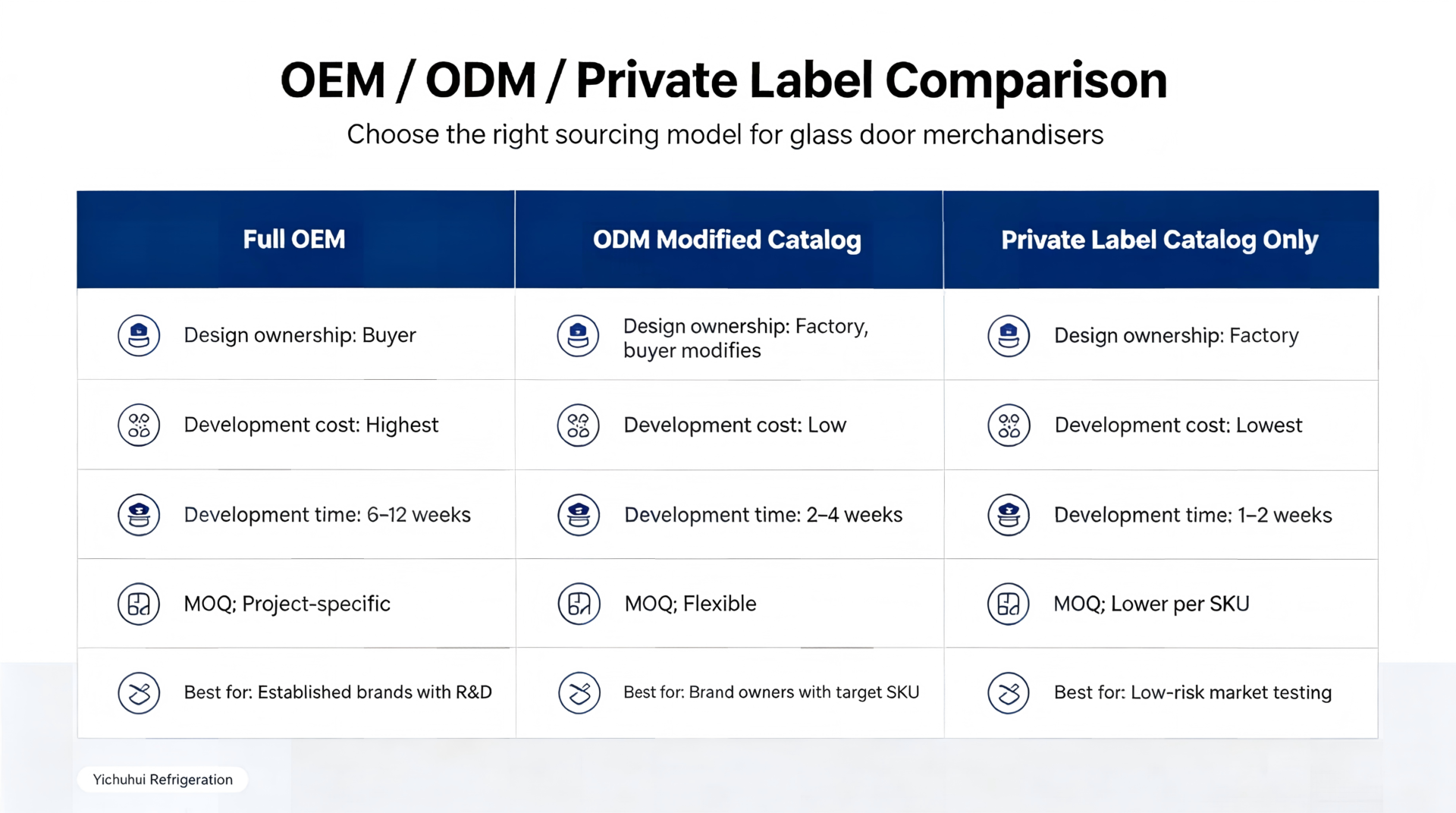
Three sourcing models exist: full OEM, ODM, and pure private label. The right pick depends on whether you own the design (OEM), want a proven base plus branding (ODM), or only want a logo on an off-the-shelf catalog SKU (private label). Each carries different development cost, MOQ behavior, and time to market.
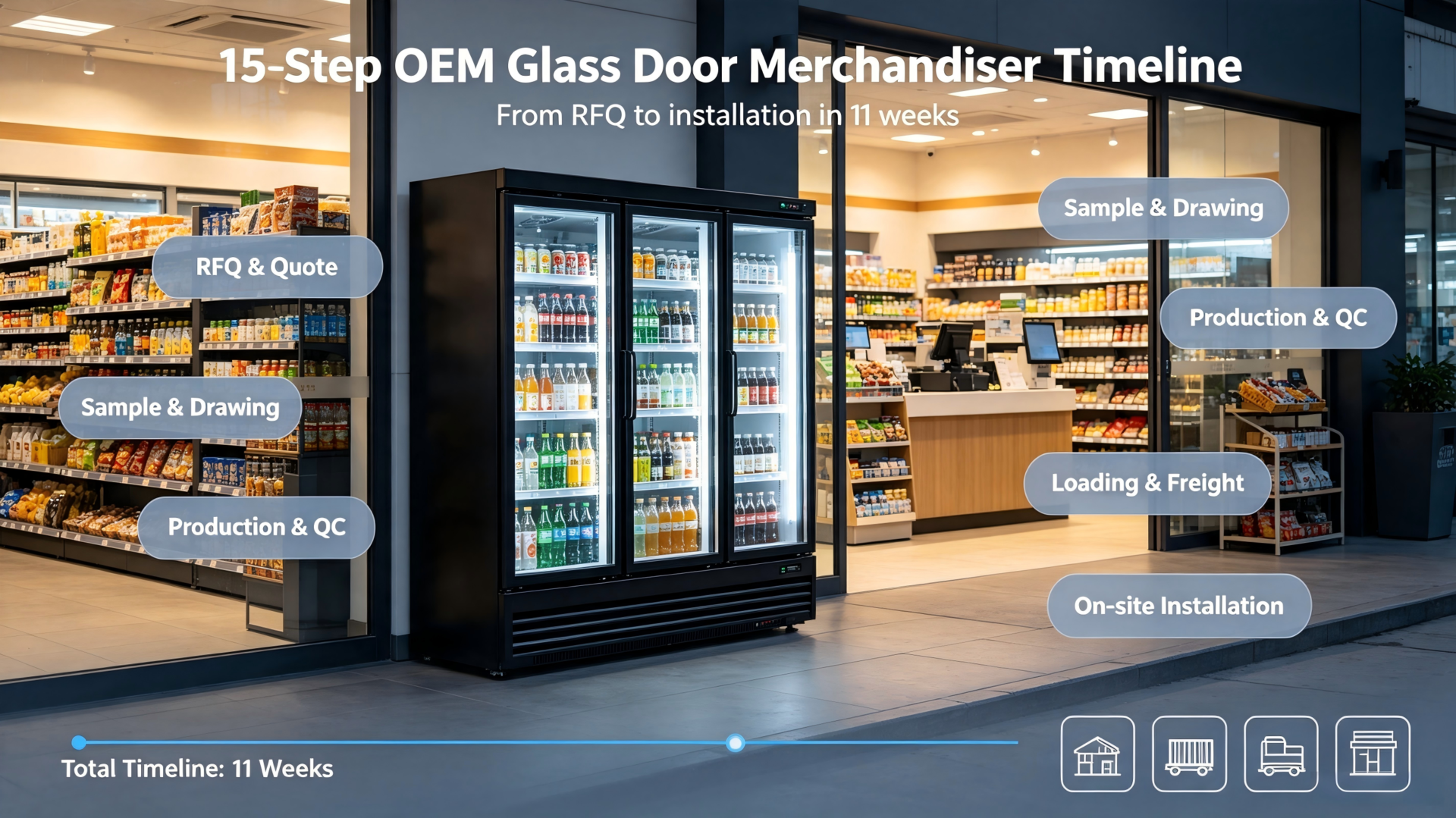
The typical OEM beverage cooler production timeline is 11 weeks from paid sample to first container for a beverage merchandiser running on R-290 refrigerant with bilingual UI. A paid sample ships in 7 to 9 days by air; mass production takes 28 days; rail freight adds 18 days from Zibo to Almaty via Alashankou.
Compliance is project-specific, not catalog-priced. EAC (Russia, Kazakhstan, Belarus), GOST-R (Russia), SASO (Saudi Arabia), SABER/Saber (Saudi product safety), GCC G-Mark, and CE all require different files, lead times, and notified-body partners, and the exact cost depends on destination country and SKU.
R-290 (propane) is the default refrigerant for new OEM beverage cooler builds in 2026 because of its GWP of 3 and the EU F-Gas Regulation 2024/573 phase-down. The trade-off is that R-290 is an A3 mildly flammable refrigerant, so charge size, cabinet volume, and ventilation need to be specified up front.
The 12-field RFQ below is the single highest-ROI artifact in this guide. Sending it before the first sales call cuts the quote cycle from weeks to days and removes the back-and-forth on voltage, refrigerant, climate class, and UI language.
1. Why Glass Door Merchandisers Win in 2026
Three forces line up in 2026 to make the glass door merchandiser the smartest private label bet in commercial refrigeration. First, China will fully ban production of refrigerators using HFC refrigerants starting in 2026, and every factory exporting to the EU, GCC, and CIS already has R-290 and R-600a lines running at full utilization. For the complete R-290 technical reference for commercial refrigeration, including charge-size limits under IEC 60335-2-89:2022 and EU F-Gas phase-down schedules, see our parent R-290 refrigerant guide. Second, the global commercial refrigeration equipment market sits in the 43 to 142 billion band depending on scope, with Asia Pacific holding 30% to 45% of unit deployment and the Middle East and Africa posting the highest CAGR from a small base (global commercial refrigeration market 2026 deep dive). Third, GCC and CIS retailers are refreshing aging fleets, and the buyers running those refreshes are the same distributors a private label brand can supply under their own logo.
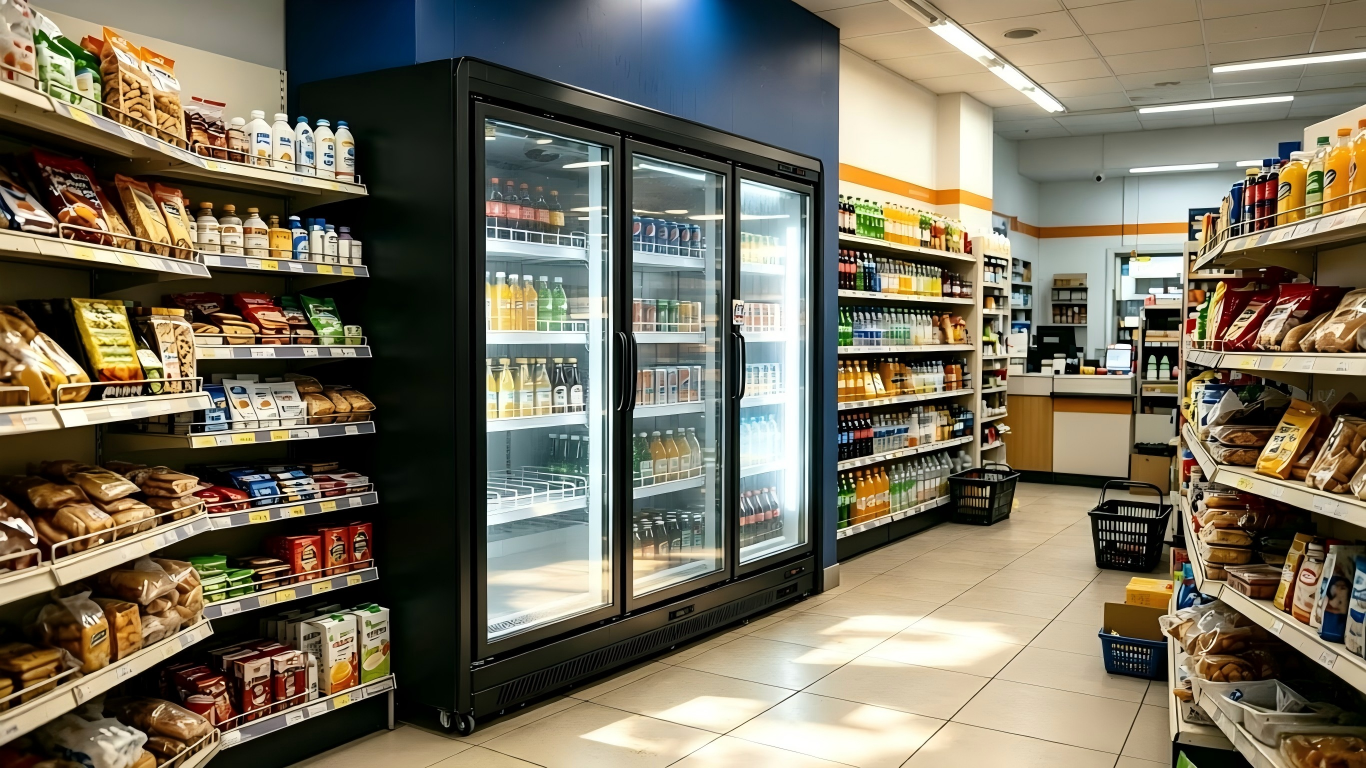
The glass door category is the right one because it sits at the visible edge of every beverage aisle. A 680-liter three-door merchandiser with brand-color back panels and Cyrillic UI is the kind of unit a beverage distributor can place in 30 stores, own the visual identity end-to-end, and recoup the CAPEX from category GMV lift rather than equipment depreciation. For a procurement director running a convenience store chain, a hotel kitchen, or a supermarket rollout, the glass door merchandiser is the cabinet that earns its shelf space back inside 18 months. See the Central Asia beverage merchandiser case study for a documented 28% GMV lift and an 18-month payback.
Quick scan: is this category right for your project? If your end customer is a beverage retailer, convenience store, supermarket, hotel bar, or restaurant chain that displays chilled drinks behind glass, the answer is yes. If your end customer is a kitchen that cooks, a pharmaceutical warehouse, or a food processor that needs a walk-in, the answer is no. Those are different product lanes and outside the scope of this guide. For the per-channel product-line fit, see our supermarket glass door merchandiser solutions, convenience store cooler lineup, restaurant display fridge range, and hotel kitchen refrigeration packages.
Curious how an OEM cooler build actually performs in a real chain? See our how that 11-week rollout played out in Almaty, with 28% GMV lift, 18-month payback, R-290 refrigerant, and 18-day rail.
2. OEM, ODM, or Private Label: Pick the Right Model
A private label beverage cooler brand usually starts with one of three sourcing models, and the choice dictates everything downstream. OEM means the buyer owns the design and the factory builds to spec. ODM means the buyer selects a proven base model from the factory’s catalog and layers branding, color, and minor modifications on top. Pure private label means the buyer takes an off-the-shelf catalog SKU and only adds a logo and packaging. The three are not interchangeable, and most first-time private label buyers under-estimate how much the model affects MOQ, development cost, and time to market.
Existing 3-door unit, Pantone-matched back panel, branded packaging
Catalog unit with logo decal on door
The practical read is this: if you already have a CAD drawing and a refrigerant spec, OEM is the right path. If you have a Pantone code and a brand book but no engineering team, ODM is faster and cheaper. If you want to test whether your customers will pay a premium for “your” cooler, start with private label on a catalog SKU and graduate to ODM once the first 200 units are sold.
One nuance that catches first-time buyers: MOQ in OEM/ODM/private label commercial refrigeration is project-specific, not a fixed number on a price list. It depends on SKU count, customization depth, refrigerant, certification scope, and packaging line changeover. A factory that quotes “MOQ 50” on a website is giving you the floor for the simplest case. A real OEM project with three SKUs, bilingual UI, and CE/EAC files moves the floor based on the customization stack. The honest answer is in your RFQ reply, not on the catalog page.
For a fuller breakdown of when each model fits a commercial refrigeration strategy, the parent OEM/ODM methodology guide walks the methodology side. This article is the operating layer that turns the model choice into a sample run and a container booking.
3. Sample to Container: The 15-Step OEM Timeline
The 15 steps below are the canonical OEM/ODM timeline for a private label glass door merchandiser export project. Each step has a typical duration, an owner, and a documented deliverable. Add the durations and you get the 11-week window you should plan around for a standard three-door merchandiser on R-290 with bilingual UI.
#
Step
Owner
Typical Duration
Deliverable
1
RFQ submission
Buyer
Day 0
12-field RFQ (see Section 8)
2
Quote review & clarification call
Both
Day 1–2
Aligned spec sheet
3
Sample fee payment (T/T)
Buyer
Day 2–3
Bank receipt
4
Engineering drawing release
Factory
Day 3–5
CAD + refrigerant + BOM
5
Sample build (air-cooled, R-290, bilingual UI)
Factory
Day 5–8
One finished cabinet
6
Sample QC + photo / video report
Factory
Day 8
Inspection record
7
Sample crating and air freight
Factory
Day 8–9
AWB
8
Sample arrives at buyer site
Buyer
Day 9–11 (Almaty / GCC / SE Asia)
Physical cabinet
9
Buyer inspection and sign-off
Buyer
Day 11–14
Signed golden sample form
10
Deposit payment (typically 30% T/T)
Buyer
Day 14–15
Bank receipt
11
Mass production (28 days for ~48 units)
Factory
Day 15–43
Production batch
12
Final QC, aging test, and photos
Factory
Day 43–45
QC dossier
13
Crating, export docs, container loading
Factory
Day 45–47
Bill of lading
14
Sea or rail freight to destination
Logistics
Day 47–65
Delivered container
15
On-site install and commissioning
Buyer + factory engineer (optional)
Day 65–77
Operational cabinets
The timeline is realistic for a 48-unit single-SKU build on an existing platform. It stretches if you add a new platform, multiple SKUs, new tooling, or a notified-body CE/EAC file that needs third-party lab testing. It compresses if you skip the bilingual UI step (saves around 10 days), pick a catalog ODM unit (saves around 14 days), or book air freight for the production batch (replaces rail with 5 to 7 day air, at 4 to 6× cost).
The single biggest slippage in real OEM projects is documentation, not engineering. Buyers who leave CE, EAC, SASO, SABER, and packaging artwork until week 6 lose their container slot. Buyers who file the certification paperwork in parallel with sample build keep the 11-week window.
Pavel, procurement lead in Tashkent. Pavel runs a 60-store beverage chain in Uzbekistan and lost his first container slot in 2024 because his EAC paperwork started at week 4 instead of week 1. The cabinet sat in Dostyk for 19 days waiting on a certificate number. The fix was cheap: start the EAC file the same week the sample ships. On his second order, the RFQ carried the EAC scope up front. The container landed in week 11 with paperwork already cleared. For a procurement lead with a similar RFQ on the desk, you can contact the Yichuhui OEM engineering team directly to lock the certification scope before the sample ships.
4. Compliance Map for Central Asia, GCC, and SE Asia
Compliance is the part of an OEM beverage cooler export that most first-time buyers under-budget and under-time. Every destination market has its own paperwork stack, and the cost and lead time swing with the destination country, the SKU count, and whether a notified body already holds a horizontal certificate on the platform model. Exact cost and lead time depend on destination country, SKU, and certification body, and your OEM should reconfirm them on a per-project basis.
Central Asia and CIS (Kazakhstan, Uzbekistan, Kyrgyzstan, Russia)
EAC certificate (Eurasian Conformity) for Kazakhstan, Russia, Belarus, Armenia, Kyrgyzstan. Issued by an EAC-notified body based on a technical file including test reports, refrigerant safety data sheet, and Russian-language user manual.
GOST-R (Russia) and GOST-K (Kazakhstan) overlap with EAC; for most beverage coolers a valid EAC TR TS 004/2011 (low-voltage) and TR TS 010/2011 (machinery safety) file is accepted at customs. The exact text of both Technical Regulations is published on the official EAEU Technical Regulation portal — confirm with your EAC-notified body which TR series applies to your platform model and SKU count before issuing the RFQ.
EAC label and markings in Russian plus local language, with manufacturer name, country of origin, EAC mark, and refrigerant charge.
Gulf Cooperation Council (Saudi Arabia, UAE, Kuwait, Qatar, Bahrain, Oman)
SASO (Saudi Standards, Metrology and Quality Organization) for Saudi Arabia; importers register the SKU on the SABER platform and upload a Certificate of Conformity (CoC) per shipment.
SABER platform is the online product registration system; SABER Certificate of Conformity for the shipment plus SABER Product Certificate for the SKU.
GCC G-Mark or GCTS for the wider GCC; tracks low-voltage and EMC requirements aligned with IEC standards.
Energy efficiency labeling is separate in Saudi Arabia and the UAE.
Southeast Asia (Vietnam, Indonesia, Philippines, Thailand, Malaysia)
CE marking is not legally required but is widely accepted as a baseline technical file.
Local language labels and user manuals are mandatory (Vietnamese, Bahasa Indonesia, Thai, etc.).
SNI (Indonesia), TCVN (Vietnam), TIS (Thailand) are the national standards; for most commercial refrigerators these are covered by an IEC 60335-2-89 test report on the platform model. The full standard text is published by the International Electrotechnical Commission (IEC 60335-2-89:2022); your OEM should reference the edition year and the specific Annex on charge limits in the test report.
Energy labeling is active in Thailand and Indonesia; Vietnam is rolling one out through 2027.
Documentation Stack to Send Your OEM Up Front
Send the destination country, voltage (220V/50Hz is the regional default), refrigerant type and charge (R-290 preferred, R-600a in some markets), climate class (3 or 4), bilingual UI label scope, user manual language list, packaging artwork in destination language, and any retailer-specific compliance such as ISO 14001 documentation.
R-290 (propane) is an A3 mildly flammable refrigerant under ISO 817. Charge size must stay below IEC 60335-2-89:2022 limits (150 g for a sealed system, up to 500 g for a self-contained unit with enhanced ventilation). Your OEM should specify charge size, refrigerant data plate, and any leak-detection accessory in the quote. For a fuller read on R-290 vs R-600a vs R-134a in commercial beverage coolers, see the R-290 benefits guide.
5. Branding, UI, and Documentation: Lock Before Production
The single highest-ROI investment in any OEM beverage cooler project is the time spent locking branding, language, and documentation before the production line is set. Every change after the golden sample is signed costs money and days. The four artifacts below are the ones you want to lock at week 2, not week 8.
1. Logo artwork in vector format. Send AI or PDF vector files with Pantone references for each color. Avoid bitmap (PNG, JPG) logos for the door decal, which pixelate at 1-meter viewing distance. A factory print shop needs a Pantone-matched color sheet and either a vector file or a high-resolution TIFF (300 dpi at final size).
2. Door decal and back-panel artwork. The door decal is the highest-visibility branding surface. For glass door merchandisers, decals go on the door mullion and the door-top sign panel. The back panel is the visible interior surface behind the product; Pantone-matched acrylic with edge-lit LED is the standard for premium SKUs. Send a Pantone chip set, not a screen color reference; color match to ΔE ≤ 2 is normal, screen references shift with every monitor.
3. Bilingual UI labels. Temperature display, defrost indicator, error codes, energy class badge, and on/off markings. For Russian-speaking markets this is Russian plus Kazakh; for GCC this is Arabic plus English; for Southeast Asia this is the local language plus English. Plan 30 to 50 unique labels per cabinet; ask your OEM to print, abrasion-test (ASTM D3363, 1,000 cycles at 500 g), and ship pre-applied.
4. User manual, warranty card, packaging artwork. User manuals should be bilingual, A5 size, and PDF-printable on standard offset. Warranty cards are usually a single bilingual card inside the cabinet. Packaging artwork includes the master carton print (your logo, SKU, destination language) and the wooden crate label, also bilingual with handling marks.
Lina, brand director in Riyadh. Lina runs a private label sparkling water brand and shipped her first 60-cabinet order with all-English UI because “we’ll translate later.” The Saudi customs hold lasted four days because the energy class badge was not in Arabic. The fix on order two cost nothing: the OEM reprinted the labels in Arabic and English and shipped them pre-applied. Lina’s lesson: lock bilingual UI in the sample run, not the production run.
6. Inside the Factory: A 30,000 m² Single-Site Plant
The factory floor is where OEM projects either survive or slip. A single-site plant with metal fabrication, foam injection, glass-door assembly, refrigerant charging, and final QC under one roof can run 10 to 15 OEM projects in parallel without cross-contamination of parts or branding. A multi-site operation that outsources glass doors or foam panels loses that flexibility and adds 7 to 14 days to every change order.
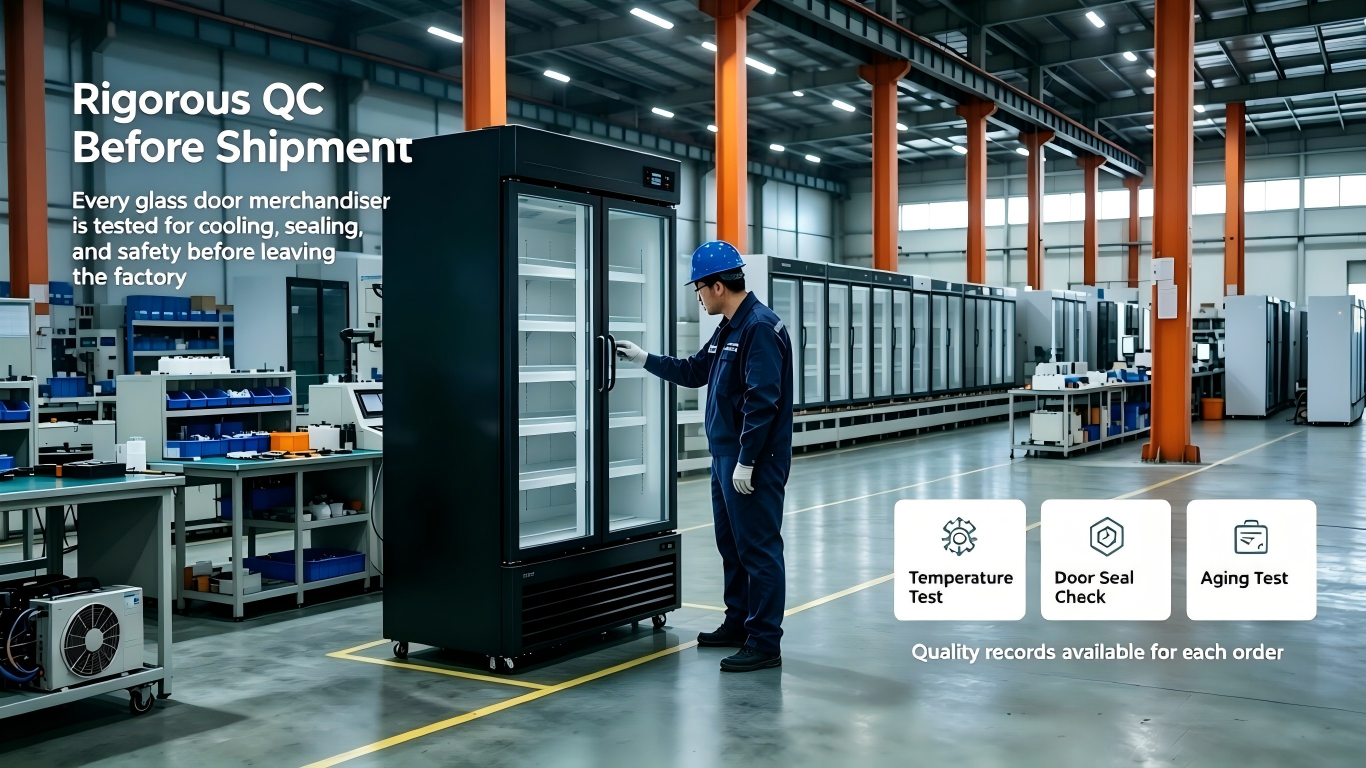
A typical 30,000 m² beverage cooler plant runs the following stations in sequence: sheet metal fabrication (laser cut and bend), foam injection (cyclopentane or HFO), cabinet assembly, vacuum panel insertion for premium SKUs, glass-door sub-assembly (low-e tempered double-pane with heated mullion), refrigerant charging station (R-290 or R-600a with mass-spec leak check), electrical harness installation, LED bar mounting, back-panel insertion, UI label application, and final QC including a 24-hour aging test under climate class conditions.
Three operational details that matter for an OEM buyer:
Climate chamber. A factory with an in-house climate chamber rated for Class 4 (32 °C ambient, 55% RH) can validate your SKU in the same building it builds it. Class 3 testing (25 °C) is the CE minimum; Class 4 is the right rating for GCC retail floors.
Refrigerant charging. R-290 charging should happen at a dedicated, ventilated station with a calibrated cylinder, a mass-flow meter, and a leak-check log per unit. Ask for the charging log on a random production unit; the data plate and the log should agree to within 2 g.
Golden sample retention. A factory should keep a signed golden sample on the line for the duration of your production run, so that any drift in color, label placement, or finish can be checked against the reference rather than against memory.
For a fuller picture of the people, certifications, and capacity behind the line, see the Yichuhui about page and the R-290 refrigerant guide for the refrigerant-transition context that shapes OEM line decisions in 2026.
Want to see the actual OEM line, the climate chamber, and the charging station before you commit? Ask for a 30-minute video walkthrough of the Yichuhui facility and a sample run on your target platform. Most buyers do this during week 1 of the RFQ cycle.
7. Case Study: 48 Units to Almaty in 11 Weeks
In March 2023, Aigerim Tursunbayeva, CFO of a Kazakhstan beverage distributor, sent a 12-field RFQ to a shortlist of three Chinese OEMs. Her chain was running 16 stores in Almaty and Shymkent with a target to grow to 52 stores within 12 months. The glass door merchandiser she needed had to handle a −30 °C winter floor, a +32 °C summer ceiling, bilingual UI in Russian and Kazakh, and brand-color back panels for three SKUs (cola red, energy-drink cobalt, sparkling-water amber). The full case write-up is in our documented Almaty rollout case study; the timeline below is the operating snapshot.
Day 1–2: RFQ sent with Pantone references, Cyrillic + Kazakh UI scope, target voltage 220V/50Hz, refrigerant preference R-290, climate class 4. Two OEMs quoted 35-day sample windows; the third quoted 9 days.
Day 9: Paid sample arrived by air freight in Almaty. The cabinet had the bilingual UI labels already applied, with no rework charge. Pantone match on the red back panel was ΔE 3.5 (one round-trip swatch exchange fixed this to ΔE ≤ 2).
Day 14: Aigerim signed the golden sample form and wired a 30% T/T deposit. Mass production started the same week.
Day 43: First 48-unit batch finished production, passed 24-hour aging test, and was crated in plywood with edge protectors.
Day 47: Containers loaded at Zibo, railed west to Alashankou, then south to Almaty.
Day 65 (week 11): Containers cleared customs at Dostyk and arrived at the Almaty warehouse. Install started the same week.
By August 2023, the first wave of 48 cabinets was live across the pilot store cohort. The chain continued the rollout into newly opened stores over the following quarters and reached the 52-store mark by May 2024, with replenishment orders landing every 90 days. The full 12-month results (28% beverage category GMV lift, 18-month payback on equipment CAPEX) are documented in the case study linked above. Aigerim’s operating notes are short and worth quoting directly:
“The first time we opened the sample crate, the labels were already in Russian and Kazakh. Nobody else had offered that.” — Aigerim Tursunbayeva, CFO, distributor side
The takeaway for a private label brand owner is the operational fact that Aigerim’s first order was inside 11 weeks because the RFQ carried the UI scope, the climate class, and the Pantone references up front. OEM timelines collapse when the RFQ is complete; they stretch when the RFQ is vague.
For a parallel reference in a different climate envelope, the Southeast Asia supermarket glass door merchandiser case study walks a Vietnam supermarket chain that cut equipment spend by 45% by switching from a Japanese brand to a Chinese OEM with the same 12-field RFQ discipline.
8. RFQ Checklist: 12 Fields to Send Your China OEM
The 12 fields below are the ones you want in every RFQ for a glass door merchandiser OEM/ODM project. Send them before the first sales call. A complete RFQ turns a 7–14 day quote cycle into a 24–48 hour one.
Target destination country and port of entry — drives voltage, frequency, refrigerant rules, and certification scope.
Voltage and frequency — 220V/50Hz is the default for most of Central Asia, GCC, and SE Asia; 110V/60Hz is the US exception.
Cabinet type and capacity — single-door, double-door, three-door; volume in liters; counter-height vs full-height.
Refrigerant preference — R-290 (propane, GWP 3) is the default for 2026 OEM builds; R-600a is the alternative in some markets.
Climate class — Class 3 (25 °C) is the CE floor; Class 4 (32 °C) is the right rating for GCC retail floors and Central Asian summers.
Temperature range — beverage holding is typically −1 °C to +10 °C; beer and wine have different targets.
Lighting — LED bar color temperature (4000 K is neutral white; 3000 K is warm); edge-lit back panel if requested.
Branding scope — logo decal on door, back panel artwork with Pantone references, packaging artwork, UI label language list.
UI language list — bilingual labels per cabinet (e.g., Russian + Kazakh, Arabic + English, Vietnamese + English); quantity per language.
Certification scope — CE, EAC, SASO, SABER, GCC G-Mark, IEC 60335-2-89 test report, energy-labeling program registration.
Target quantity per SKU and timeline — first-order volume, repeat-order forecast, target ship date, repeat-order cadence.
Add three attachments to every RFQ: a sketch or reference photo of the target cabinet, the Pantone chip set (digital is fine for round 1; physical chips for color-match rounds), and any retailer-specific compliance file. With these in the first email, your OEM can return a sample plan, an FOB quote, and a freight estimate inside 48 hours.
9. Frequently Asked Questions
How do I start a private label beverage cooler brand from scratch? Begin with one SKU on an existing OEM platform. Pick a three-door merchandiser between 600 L and 800 L, specify R-290 refrigerant, climate class 4, and 220V/50Hz. Send the 12-field RFQ in Section 8 to two or three short-listed factories, ask for a paid sample on each, and pick the one that delivers the bilingual UI in the sample run. First container can ship inside 11 weeks; reinvest margin into a second SKU and a Pantone-matched back panel program.
What is the MOQ for a glass door merchandiser OEM order from China? MOQ is project-specific, not a fixed number on a price list. It depends on SKU count, customization depth, refrigerant, certification scope, and packaging line changeover. A simple private label with one SKU and one logo decal moves at the lowest MOQ; a multi-SKU ODM with Pantone-matched back panels and bilingual UI moves higher. Your OEM should quote MOQ in the first reply, tied to your specific 12-field RFQ, not from a generic catalog page.
How long does OEM beverage cooler production take? A standard three-door glass door merchandiser on R-290 with bilingual UI runs 9 days for paid sample, 28 days for mass production, and 18 days rail freight from Zibo to Almaty, an 11-week total. Air freight compresses transit to 5 to 7 days at 4 to 6× cost. New tooling, multiple SKUs, or third-party certification testing can add 2 to 6 weeks.
Can a Chinese OEM put my logo on the fridge doors and packaging? Yes. Door decals are usually vinyl or 3M-printed, applied at the factory. Back-panel artwork is typically a Pantone-matched acrylic sheet with edge-lit LED. Packaging artwork is printed on the master carton and the wooden crate label. Send vector logo files, Pantone references, and any retailer-specific mark requirements. Lead time for branding artwork is 5 to 7 days inside the factory.
What files are needed for GCC import of a glass door beverage cooler? Saudi Arabia requires a SABER Product Certificate (per SKU) and a SABER Certificate of Conformity (per shipment). The UAE, Kuwait, Qatar, Bahrain, and Oman require a GCC G-Mark file or a national conformity certificate. Energy-labeling registration is mandatory in Saudi Arabia and the UAE. Exact cost and lead time depend on destination country and SKU; your OEM should bundle the file list in the quote.
What is EAC certification for a beverage cooler in Kazakhstan? EAC (Eurasian Conformity) is required for Kazakhstan, Russia, Belarus, Armenia, and Kyrgyzstan. The file is built on TR TS 004/2011 (low-voltage) and TR TS 010/2011 (machinery safety) test reports, a Russian-language user manual, and a refrigerant safety data sheet. The certificate is issued by an EAC-notified body and is valid for 1 to 5 years depending on the scheme. Cost and lead time depend on whether your platform already holds a horizontal certificate.
Does SASO compliance apply to beverage display cabinets in Saudi Arabia? Yes. SASO manages Saudi Arabia’s product conformity scheme through the SABER platform. A glass door merchandiser imported into Saudi Arabia needs a SABER Product Certificate issued by a SASO-approved conformity body and a shipment-level Certificate of Conformity. Energy-labeling registration is separate. Allow 4 to 8 weeks for the file if your platform does not already hold a Saudi certificate.
Is the OEM beverage cooler sample fee refundable? Sample fees cover the engineering, the materials, the labor, and the air freight. They are typically refundable against a confirmed production order above an agreed volume threshold. The exact threshold depends on the factory and the project. Get the sample-fee-refund policy in writing before wiring the sample payment, and ask for the refund trigger to be tied to a deposit date rather than a calendar quarter.
Can a Chinese OEM customize voltage and frequency for Central Asia? Yes. 220V/50Hz is the standard for Kazakhstan, Uzbekistan, Kyrgyzstan, and Russia, and is a no-cost option on most platforms. 110V/60Hz for North America is also standard. Less common voltages (e.g., 127V/50Hz for some legacy sites in Brazil) require a transformer or a different compressor and add cost. Specify voltage and frequency in your RFQ; do not assume the factory will infer it from the destination country.
Is own-brand glass door cooler better than a distributor brand for my market? It depends on the scale of your operation. An own-brand cabinet lets you control the visual identity, capture higher margin, and build retailer loyalty across a multi-store rollout. A distributor-brand cabinet is faster to launch and lower risk if you are testing the market. Most private label buyers in Central Asia, GCC, and SE Asia start with a distributor-brand test on one SKU, then graduate to own-brand once the category proves out.
Conclusion
Glass door merchandiser OEM in 2026 is an 11-week, single-digit-thousand-dollar sample that opens the door to a private label cooler line under your own brand. The operating recipe is straightforward: send a complete 12-field RFQ, pick the OEM that delivers bilingual UI in the sample, lock R-290 and climate class 4 up front, file the EAC/SASO/SABER paperwork in parallel with the sample build, and book the first 48-unit container on the rail lane that matches your destination. The data backs the bet: a 28% beverage category GMV lift and an 18-month payback on equipment CAPEX, documented in the Central Asia case study; a 45% equipment spend cut and faster rollout, documented in the Southeast Asia supermarket case study; a 30% to 45% Asia Pacific share of the global commercial refrigeration equipment market, documented in the global market deep dive. For the full Yichuhui OEM case studies library — including hotel kitchen and supermarket rollouts — return to the Cases hub. The next step is yours.
Yichuhui (Zibo) Refrigeration Equipment Co., Ltd. A 30,000 m² production base in Zibo with 20+ years manufacturing glass door merchandisers, air-cooled beverage coolers (air-cooled beverage cooler, luxury air-cooled beverage cooler), and multi-deck open display merchandisers. CE and ISO 9001 certified. Sales and engineering support in English, Russian, and Arabic.
Send your 12-field RFQ today. 48-hour reply, weekdays and weekends.